We may earn a commission when you buy through our links, at no extra cost to you.
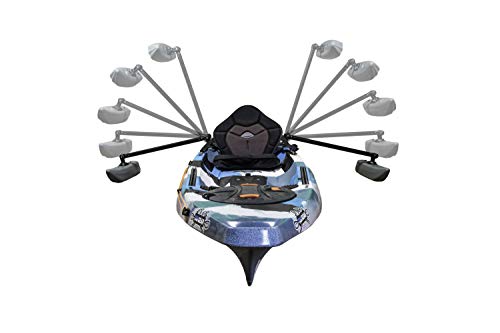
People consider adding outriggers to their kayaks for a host of reasons – the primary concern being stability. Kayak outriggers ensure that fishing kayaks remain stable and maintain balance at all times. As such, if you learn how to use kayak outriggers rightly, you’re much safer wading through the water; this applies for both paddle kayaks and kayak trolling motors.
With outriggers, you can add sails to your kayak or convert your recreational boat into a fishing podium. More so, if you’re looking to make your kayak more balanced, they pose as viable solutions.
However, outriggers have their own set of pros and cons. And to help you make the right choice among the available choices, we have compiled this buying guide that you can refer to.
Want To Rig Outriggers? Here’s What You Should Know.
Stability
Stability is the sole reason for kayakers to add outriggers to their boats. Even so, a stable kayak can solve the following issues.
Sails
Sails add versatility to your kayak. Upon mastering them, you can extend canvas above your head for more adventurous times than sole paddling. However, before you consider a spinnaker, know that sans a keel, you cannot manage much sail.
Keels
They are the weighty, long blades that are found below the sailboat’s hull. Their objective is to provide a counterbalance to the forces that the wind generates on the sail. Kayaks do not come with keels; hence a slightly hard push can tip it over. Outriggers can avoid such problems, for they offer the requisite stability while making the kayak fit to withstand light breezes.
Tall and Well-Built fisherman
Kayaks that are designed for sight fishing are not stable enough for tall-sized and bulky anglers. Though, outriggers are a good option to have them standing tall while they try to catch some fish.
Fishing
If you’ve purchased a recreational kayak and are looking to start fishing during your kayaking expeditions, then adding outriggers is a good choice. Several fish species are caught when they’re directly cast upon.
Upon spotting your prey before casting, you can cajole them into direct strikes. And if you’re planning on trying fly fishing, then you should cast while standing and not sitting – for it is easier to do so.
All the same, if you try standing on your feet in most recreational kayaks, you may not be able to do so easily. Though, by adding a pair of outriggers, you can stand in your recreational boat comfortably.
Can Outriggers Slow Down Your Kayak?
One main drawback of outriggers is that they slow down your kayak. The study of hydrodynamics can explain the reasons for this phenomenon better. Put simply, the longer the hulls of kayaks, the speedier they can race through the waters. In general, outriggers are extra hulls that you can attach to your kayak and by adding them on you create a trimaran or catamaran.
This also indicates that the shorter the hulls, the slower the kayak will move in the waters. However, to get your kayak moving faster, you may want to add more sail to your outriggers.
Inflatable Outriggers or Solid Outriggers
You can choose to go either with inflated PVCs or Solid ones. Both have their own pros and cons.
Inflatable Outriggers
Inflatable outriggers come with a bladder that is enclosed within a tough outer membrane. You have to inflate them via mouth when hitting the waters. And for storing them, you have to deflate them. The drawback of inflatable outriggers is that though the exterior membrane though may be tough, yet it can be punctured. Now, if you’re a fisherman or you land on beaches that contain debris, then this can be an issue.
PVC Outriggers
PVC outriggers come with solid floats for greater buoyancy. Their strength lies in their robustness. You need not worry about their durability when sailing in the waters. Also, fishermen use this material on their traps and nets. Nevertheless, they are not easily storable as compared to their inflatable counterparts.
Setting up Outriggers to A Kayak
Setting up your kayaks is an important aspect that you need to ponder upon when you’re planning on adding outriggers to your kayak. Keep in mind that installing outriggers may not be that easy as you may think.
1. Mounting
For mounting the outriggers, you will require a drill for inserting holes in your kayak. More so, you have to be comfortable drilling holes in your kayak. And if you have no experience with DIY projects, setting up your outriggers to your kayak can be daunting. However, follow the instructions in the user’s guide. And bear in mind that pilot-drilling holes can ensure accuracy when concerned with larger bits.
2. Positioning
The placement of your outriggers is an important consideration. You must consider placing them near the stern of your kayak to avoid them from coming in the way of your paddle strokes. You will require open space to measure the correct size and how much clearance you have.