We may earn a commission when you buy through our links, at no extra cost to you.
Types of Right Kayak
Wind Sails
The different kinds of sails are discussed herein.
L-shaped Sails
For experienced kayak sailors, the L-shaped sails are ideal. Though, beginners are not advised to use them. They are shaped similarly to sails that are found on sailing yachts and are more conventional in style.
Though, they are more difficult to use because they need more sailing skills as compared to circle sails. Using an L-shaped sail, you can control the direction you’re traveling in by moving them.
Normally, they have a mast and some varieties come with a boom (a horizontal-shaped rod that sways from the mast and nails the base of the sail down). As a result, you can sail notwithstanding the direction of the blowing wind, rather than getting restricted to downwind sailing.
Circle Shaped Sails
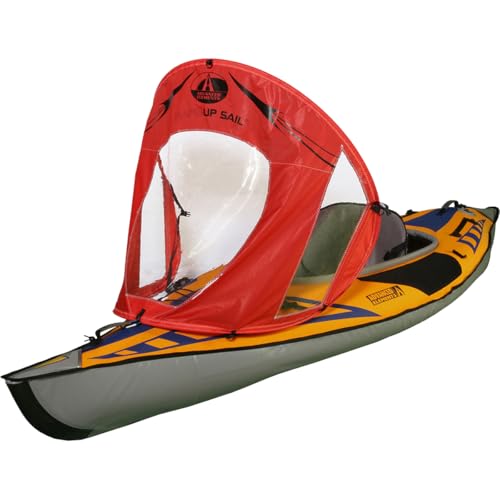
Circle-shaped sails are circular in shape and comparable to parasails or what you know as conventional sailboat sails.
If you are a beginner to kayaking, circle-shaped sails are ideal for you. They are preferred because of their easy-to-use and easy-to-control features. Moreover, they have a window to see the direction in which you’re heading.
In fact, they are perfect if you want to learn basic sailing techniques. As such, you can become familiar with their workings before moving on to advanced ones.
You can attach the circle-shaped sails to the bow of your kayak; also, they are controllable by hand. Owing to their shape and the position on your kayak, they are most useful in downwind sailing conditions when the wind is pushing your boat along.
V-shaped Sails
In the case of V-shaped sails, most of the sail’s area is atop the sail. Thus, they leave only a little area at the lower end. Hence, they tend to get in the way much more than other kinds of sails. Though, some come with clear window panels so you can look at what lies ahead.
Due to their design and height, they catch more wind. Nevertheless, they have a smaller surface area which lessens the speed of your boat. Similar to circle-shaped sails, these types of sails are also more suited to sailing downwind because they do not change direction easily.
V-shaped sails are ideal for those groups having little or no experience with kayak sails. Even so, owing to their top-heavy frame, they may not be suited for lightweight boats, particularly when strong winds are billowing.
Kayak Sail Materials
The various types of sail materials for your kayak are studied in the following details.
Aluminum and Carbon Fiber Varieties
The designs of kayak sails that have masts, such as the L-shaped sails, are composed of carbon fiber or aluminum (which is lightweight); both varieties are portable and durable.
The outer edges of circular sails are stiff and are given shape via a batten, which is a supporting rod. The batten of circular sails is often composed of plastic to make them easily foldable when storing them.
Plastic
The majority of modern kayak sails are composed of durable and flexible plastics; they are hard-wearing and lightweight. However, you should make sure to clean the plastic sails after every use, particularly if you’ve gone sailing. Always remove any chemicals and salt that may have stuck from the water. By doing so, you prevent the plastic from degrading and splitting.
In some sail designs, the masts of kayak sails could also be constituted of plastic, which is not as strong as aluminum or carbon fiber.
Laminated Cloths
Laminated cloth is used in the previous models of kayak sails and L-shaped sails. As compared to plastic, laminated cloth has greater tensile strength and does not rupture during strong winds.
Though, on the downside, the laminated cloth is heavy and thick and, in turn, can be difficult to set up and store.
Advantages of Kayak Wind Sail
One of the primary benefits of installing wind sails on your kayak is that you gain speed. Yes, you can use the power of the wind to travel faster with wind sails, as compared to wasting your energy via paddling.
More importantly, if you are covering long distances, having wind sails can be useful. Because you can cover a great distance without getting too tired. Also, you reach your destination more quickly with their use. With the help of wind sails, you can take a break from paddling to eat lunch or enjoy a drink as well.
Apart from that, they can add the fun element to your kayak and make your ride more interesting, rather than paddling which can get boring and tiring.
Disadvantages of Kayak Wind Sail
Hosting wind sails on your kayak has certain disadvantages too. Yes, they can affect the stability of your kayak. They can lead to destabilizing your boat when strong winds are blowing.
Big sails can help you harness the wind’s powerful force, though they have to be positioned correctly; or else, the likelihood of your boat toppling over increases.
A sail attached to your sit-inside yak also affects your ability to roll. Thus, you may have to detach the mast first or make a wet exit before your sail is secured and got back in.
Fishing and Wind Sail
Your fishing expedition can be much more fun with a sailing kayak. Also, using wind power, the sails can take you to your favorite fishing spot; and that too, without you exerting much effort. More so, your hands are free for fishing while you are driving around in your canoe-like boat.
Besides, you can go trolling with the help of sails, which can help to ride your boat quietly without disrupting the fish. More so, they offer an economical trolling option.
When can I use a Kayak Wind Sail?
Kayak sails can be used when you’re out on paddling trips. Also, they are handy for touring kayaks or sea kayaks when they’re out on a trip for a couple of days.
You can also use them when venturing on canoeing or water kayaking expeditions, or when a light breeze is blowing, to gain power over the water.



 Best Kayak Racks for RAM 2500