We may earn a commission when you buy through our links, at no extra cost to you.
The Dodge Grand Caravan is one of the most underrated family kayak transport vehicles out there. The long roof, factory raised rails, and stow-and-go interior make it a genuinely capable family hauler for kayaks. I’ve put together this list based on what actually fits, loads cleanly, and holds on the highway.
Dodge Grand Caravan Kayak Rack Buying Guide
Nobody talks about the Dodge Grand Caravan as a great kayak transport vehicle. But it is one. I spent three summers using mine as the primary family paddling car, and the long roof, factory raised rails, and stow-and-go interior made it better suited to the job than the SUVs most of my paddling friends were driving. This guide covers what I learned, including the things I got wrong before I figured out what actually works.
Why the Caravan’s Long Roof is a Hidden Advantage
The Caravan’s roofline is genuinely long. The factory crossbar span is wider than on most compact and mid-size SUVs, giving you two practical advantages: you can space crossbars further apart for better weight distribution on longer boats, and two full-size recreational kayaks on J-racks have plenty of clearance between them. Hull contact between kayaks during loading is one of the most common sources of dings and scratches — the Caravan’s roof width largely eliminates that problem.
I found this out by accident the first summer. I had been spacing my crossbars too close together out of habit from a shorter SUV. A paddling friend pointed out I could move them 12 inches further apart on the Caravan roof and dramatically improve stability. That single adjustment made the whole setup feel more planted on highway drives. Take advantage of the Caravan’s roof length — it is genuinely one of the better rooftop kayak carry platforms in the family vehicle category.
Do You Have the Right Trim? Checking for Factory Rails
This is the step most Caravan owners skip and it causes real frustration. Not all Grand Caravan trims include factory raised roof rails. Walk out to your Caravan right now and look along the roof edge — raised rails run the length of the roof with a gap underneath them. If you see a flat rail flush with the roof surface, that is a decorative rail, not a functional one, and it will not accept crossbar feet. If your Caravan does not have functional raised rails, you need either aftermarket roof rails or a naked-roof door-frame crossbar system from Thule or Yakima before any J-rack can mount.
Loading at 68 Inches: What to Expect
The Caravan’s roof height is around 68 inches — taller than a sedan but shorter than a full-size SUV or truck. Two-person loading at this height is comfortable and fast. Solo loading is achievable with good technique but takes practice. My personal approach was to rest the stern on a pool noodle attached to the rear crossbar and walk the bow up from the front. It takes about 90 seconds once you have done it a few times. A cheap plastic two-step stool from any hardware store also makes a meaningful difference. Foam-padded J-bars like the Taelakeni set are forgiving while you learn, because the pads soften the inevitable awkward contacts.
Matching the Rack to How You Actually Paddle
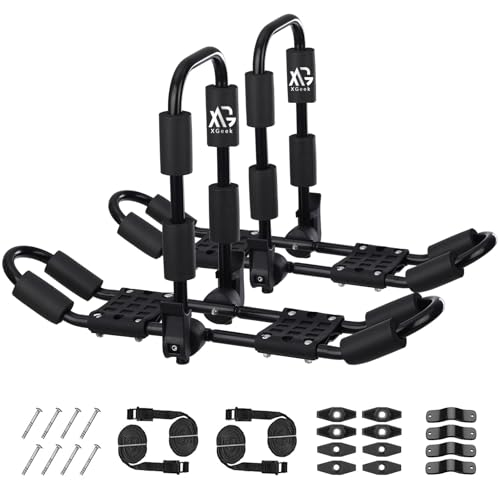
If you paddle with your partner and kids every weekend through summer, you want a complete two-kayak setup that is fast to deploy, reliable on the highway, and folds flat for the rest of the week. The FORWODE 2-pair is the right pick for that use case. If your family uses the Caravan for all outdoor activities across all seasons, the XGeek 4-in-1 bilateral is worth the extra investment. If you are brand new to rooftop kayak carry, start with the PIRIPARA — it is proven, affordable, and most Caravan families find rooftop carry becomes completely natural within a few trips.
One Final Tip Before You Buy
Always run bow and stern tie-down straps to the anchor points inside the door frame when the stow-and-go seats are folded. Running your kayak’s bow strap to the front tow hook and the stern strap to an interior D-ring gives you a rock-solid four-point anchor that holds through any highway speed. Also: clean the roof rail channels before installing your crossbars — grime in the channel can prevent crossbar feet from seating fully. Five minutes with a brush and soapy water before installation makes the whole process cleaner and easier.





 Best Kayak Racks for RAM 2500