


Finding a reliable kayak without spending a fortune is easier than ever. Plenty of manufacturers now offer well-built options under $300 that are suitable for fishing, recreational paddling, lake adventures, and slow-moving rivers. Whether you’re buying your first kayak or looking for a portable inflatable model, there are several choices that deliver solid stability, comfort, and durability without stretching your budget.
In this guide, we’ve selected the 5 best kayaks under $300 based on build quality, ease of use, performance, user feedback, and overall value for money. From inflatable kayaks by Intex and Advanced Elements to recreational models built for weekend outings, these picks offer a great balance of features and affordability for beginners and casual paddlers alike.
Best 5 Kayak under $300
01. Advanced Elements StraitEdge

The Advanced Elements StraitEdge is a high-performance inflatable kayak built for paddlers who want the handling of a hard-shell kayak with the convenience of an inflatable design. Featuring aluminum bow and stern ribs, multiple air chambers, and a durable PVC construction with a rugged fabric cover, it tracks well on lakes, calm rivers, and coastal waters. The spacious cockpit and supportive seat make it comfortable for extended paddling sessions.
Unlike many entry-level inflatable kayaks, the StraitEdge delivers impressive stability and directional control. It packs down for easy transport yet performs well enough for anglers, recreational paddlers, and outdoor enthusiasts looking for a dependable touring kayak. Brands like Advanced Elements, Sea Eagle, and AQUAGLIDE are often compared in this category, but the StraitEdge stands out for its balance of portability and on-water performance.
Pros:
- ✅ Excellent tracking with aluminum bow and stern ribs
- ✅ Stable and comfortable for longer trips
- ✅ Durable multi-layer construction
- ✅ Easy to transport and store when deflated
Cons:
- ❌ Higher price than beginner inflatable kayaks
- ❌ Takes longer to inflate than simpler models
02. Intex Challenger K1 1 Person Durable Vinyl Streamline Sporty Kayak
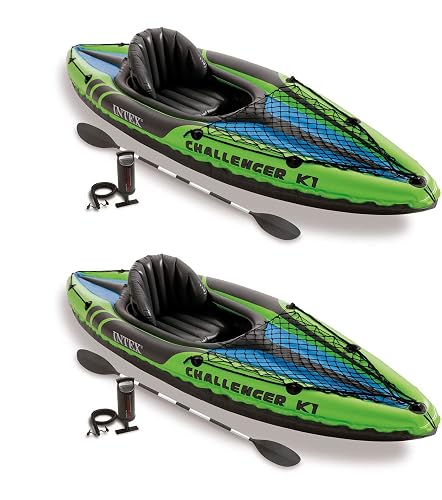
The Intex Challenger K1 is one of the most popular inflatable kayaks for beginners thanks to its lightweight design, affordable price, and easy setup. Made from durable vinyl with an inflatable I-beam floor, it offers a stable platform for casual paddling on calm lakes, ponds, and slow-moving rivers. The streamlined shape helps improve maneuverability while the removable skeg assists with tracking.
This kayak is ideal for first-time paddlers or anyone looking for a compact recreational kayak that fits easily in a car trunk. It includes an adjustable seat, aluminum paddle, repair patch, and high-output air pump, making it a complete starter package for weekend adventures.
Pros:
- ✅ Affordable entry-level inflatable kayak
- ✅ Lightweight and easy to carry
- ✅ Includes paddle, pump, and repair kit
- ✅ Quick inflation and simple setup
Cons:
- ❌ Not intended for rough water or rapids
- ❌ Vinyl material is less rugged than premium kayaks
03. Advanced Elements Lagoon1

The Advanced Elements Lagoon1 is a recreational inflatable kayak designed for smooth handling and all-day comfort. Its low-profile design, molded rubber handles, and durable polyester-covered PVC construction make it well suited for lakes, bays, and slow rivers. The adjustable padded seat provides good back support, while the compact size makes transportation and storage easy.
For paddlers looking to upgrade from basic inflatable kayaks, the Lagoon1 offers noticeably better build quality and tracking. It performs well for sightseeing, wildlife photography, and relaxed weekend outings, giving users a dependable kayak without the storage requirements of a traditional hard-shell model.
Pros:
- ✅ Comfortable padded seat for extended use
- ✅ Durable construction with quality materials
- ✅ Stable and beginner-friendly handling
- ✅ Packs into a compact carrying bag
Cons:
- ❌ Limited cargo space for overnight trips
- ❌ Better suited for calm water than open ocean conditions
04. INTEX 68303EP Excursion Pro K1 Inflatable Kayak
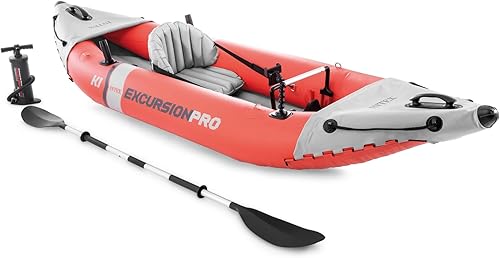
The INTEX Excursion Pro K1 is a heavy-duty inflatable fishing and recreational kayak built with SuperTough laminated PVC for improved durability and puncture resistance. Compared to entry-level inflatable kayaks, it offers greater rigidity, better tracking with removable skegs, and a higher weight capacity. Integrated fishing rod holders, mounting brackets, and storage space make it especially appealing for anglers.
Whether you’re fishing, exploring lakes, or paddling along calm rivers, the Excursion Pro K1 delivers excellent value. It includes a paddle, pump, carry bag, pressure gauge, and removable skegs, giving buyers nearly everything needed to get on the water immediately.
Pros:
- ✅ Tough laminated PVC construction
- ✅ Excellent for recreational fishing
- ✅ Includes many useful accessories
- ✅ Good tracking and stability
Cons:
- ❌ Heavier than basic inflatable kayaks
- ❌ Inflation takes slightly longer than smaller models
05. AQUAGLIDE Noyo kayak

The AQUAGLIDE Noyo is a lightweight inflatable recreational kayak built for paddlers who want dependable performance without the bulk of a rigid kayak. Its durable construction, comfortable cockpit, and responsive handling make it a strong option for lakes, slow rivers, and sheltered coastal waters. The streamlined hull offers efficient paddling while remaining stable enough for beginners.
AQUAGLIDE has built a reputation for producing quality inflatable watercraft, and the Noyo reflects that focus on durability and portability. It packs into a compact travel bag for convenient storage, making it a practical choice for campers, travelers, and anyone with limited garage space. Compared with many inflatable kayaks in its class, it offers a refined paddling experience with quality materials and thoughtful design.
Pros:
- ✅ Lightweight and easy to transport
- ✅ Stable design for recreational paddling
- ✅ Durable construction with quality materials
- ✅ Comfortable seating for day trips
Cons:
- ❌ Premium pricing compared to budget brands
- ❌ Not intended for whitewater or challenging river conditions
What to expect at this price point
Let’s be direct about what $300 buys you and what it does not. At this price point you are getting a recreational kayak designed for calm flat water — lakes, slow-moving rivers, sheltered bays. You are not getting a touring kayak, a whitewater boat, or anything designed to cover serious distance efficiently.
Hull materials at this price are polyethylene plastic or PVC (for inflatables). Both work fine for recreational use. Polyethylene scratches and dents but is impact-resistant and repairable. PVC inflatables are surprisingly tough but puncture risk is real, so always carry a patch kit.
Seats are the most common complaint about budget kayaks. Almost every kayak under $300 ships with a basic foam or thin padded seat that becomes uncomfortable after about 90 minutes. A $30–$50 aftermarket gel seat pad is one of the best upgrades you can make to any kayak in this price range — it makes a 2-hour paddle feel very different from a 2-hour paddle on stock seating.
Paddles are often not included at this price, and when they are included they are usually the worst thing in the box. Budget $50–$80 for a proper aluminum-shaft paddle. A bad paddle makes everything harder and a good one makes everything easier — it is a more impactful upgrade than any accessory on the kayak itself.
Sit-in vs sit-on-top: which is right for you
This is the first real decision to make before you buy anything, and it matters more than most people realise.
Sit-in kayaks
Your legs are inside an enclosed cockpit. You stay drier, stay warmer, and the lower centre of gravity makes the boat feel more stable for many paddlers. The tradeoff is that getting in and out requires a bit more technique, and if you capsize, re-entering in deep water is harder. Sit-in kayaks are the right choice for cooler water, coastal paddling, and anyone who wants to cover distance on flat water without getting wet.
Sit-on-top kayaks
You sit on top of a moulded hull with your legs out in front of you. Self-draining scupper holes drain any water that splashes aboard. Getting on and off is trivial, and re-entering after a capsize is straightforward even in deep water. You will get wetter from spray and paddle drip. Sit-on-tops are the right choice for warm weather, fishing, snorkelling, and any paddling where you might intentionally get in the water.
Under $300, most of the best options are sit-in kayaks. The Lifetime Tamarack Angler is the notable sit-on-top exception and it earns its place specifically because of the fishing-oriented features that suit the sit-on-top format well.
How to choose the right kayak length
Longer kayaks track straighter and move faster for the same paddle effort. Shorter kayaks turn more easily and are lighter and more manageable on land. At the recreational end of the market, the practical range is 8–12 feet.
8–9 feet: Best for kids, smaller adults, and very tight storage. Slow and wanders in wind. The Pelican Sprint 80X and Intex Challenger K1 sit here.
10 feet: The sweet spot for recreational paddling. Stable enough for beginners, long enough to track reasonably well in calm conditions. Most of the kayaks on this list are 10 feet. Correct for the vast majority of people reading this guide.
11–12 feet: Notably faster and better tracking than 10-foot boats, but harder to find under $300 in any quality. If you find yourself wanting to paddle further and faster, this is where to look when upgrading beyond the $300 bracket.
Stability, tracking, and what the numbers mean
Primary stability is how stable the boat feels when you are sitting still. Wide flat-bottomed hulls have high primary stability — they feel reassuring when you are sitting on calm water. This is what matters for beginners and fishing applications.
Secondary stability is how the boat behaves when it is leaned to one side. A boat with high secondary stability feels unstable at rest but catches itself before capsizing when leaned. This matters more for experienced paddlers on moving water and is not something you need to think about at this price point.
Tracking refers to how straight the boat goes when you paddle. Longer, narrower boats track better. Shorter, wider boats turn more easily but wander more in wind and open water. Under $300 you are trading some tracking for stability and ease of use, and that is the right trade for recreational use.
Frequently asked questions
Do I need a life jacket (PFD)?
Yes, always. In most jurisdictions it is a legal requirement to have a Coast Guard-approved PFD on board, and in many places to wear it. A basic recreational PFD costs $30–$60 and is the most important safety purchase you make alongside the kayak itself.
Can I use these kayaks in the ocean?
In calm, sheltered coastal conditions close to shore, yes. In open ocean, surf, or any exposed coastal situation, no. All five kayaks on this list are flatwater recreational boats and should be treated as such. Check the forecast and stay within your limits.
What else do I need to buy?
At minimum: a paddle ($50–$80 if not included), a PFD ($30–$60), and a way to transport it. Add a seat pad upgrade ($30–$50) and a dry bag for your phone and valuables ($15–$25). Budget $150–$200 on top of the kayak price for a complete first setup.
Should I buy new or used at this price range?
Used is worth considering. A $300 new recreational kayak and a $300 used quality kayak are very different propositions. Facebook Marketplace and Craigslist regularly have used Pelicans and Sun Dolphins in good condition for $100–$150. If you are willing to spend time looking, a used mid-range kayak beats a new budget kayak at the same price point almost every time.
Will these kayaks last?
With basic care, yes — several years of regular recreational use. Store them out of direct sunlight when not in use (UV degrades polyethylene over time), rinse off salt water after coastal use, and avoid dragging them over rough surfaces. The Pelican RAM-X hull is noticeably more durable than thin-walled budget alternatives and worth the small price premium if longevity matters to you.
