

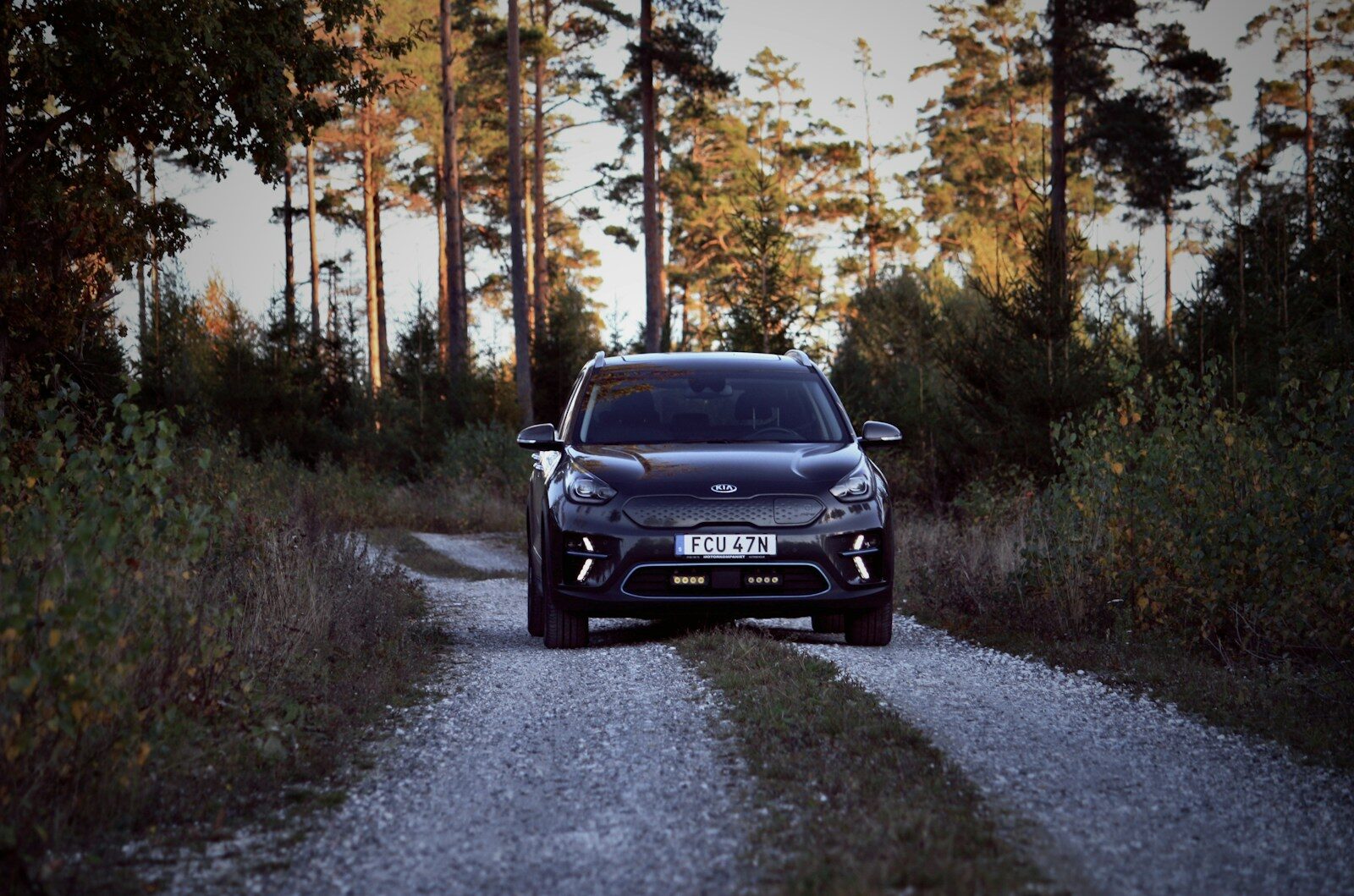
The Kia Niro is available as a hybrid, plug-in hybrid, and fully electric crossover — an eco-conscious compact with factory raised roof rails on most trims and a buyer demographic that skews toward outdoor and environmental lifestyle. The EV variant adds an important note: always verify the Niro EV’s roof dynamic load rating in your owner’s manual before loading, as EV-specific limits apply. All Niro variants share similar roof geometry. At around 61 inches of roof height, solo loading is genuinely easy on any Niro.
Best 5 Kayak J-Racks for Kia Niro
01. Yakima JayLow J-Cradle Rack
Best J-Rack for Kia Niro
The Yakima JayLow is the ideal match for the Niro — its fold-flat design minimises EV drag on commuting days for the Niro EV, J-cradle side-carry minimises loaded drag on highway drives, and at 61 inches solo loading is very manageable.
The Yakima JayLow folds to the lowest profile of any J-cradle. On the Niro EV, even empty-rack drag affects range — the fold-flat design matters more here than on a petrol vehicle. J-cradle side-carry generates less drag than flat carry, directly benefiting range on highway EV drives. Wide HullRaiser pads. Integrated loading ramp for easy solo placement at 61 inches. SKS lock compatible. 100/130 lb capacity.
Pros:
- ✅ Lowest fold-flat profile — minimises empty-rack drag on Niro EV commuting days
- ✅ J-cradle side-carry minimises loaded drag and range impact on Niro EV highway drives
- ✅ Integrated loading ramp aids solo loading at Niro’s very accessible 61″ height
- ✅ SKS lock compatible for parking security
- ✅ Wide HullRaiser pads for broad hull widths
Cons:
- ❌ Niro EV: always verify roof dynamic load rating before loading
- ❌ SKS lock cores sold separately
- ❌ Premium Yakima pricing
02. ARTIPOLY 4-in-1 Bilateral Aluminum J-Rack
Best Lightweight Multi-Sport Rack for Niro
Active Niro owners who carry multiple sports across seasons benefit from the ARTIPOLY’s aviation aluminum construction. On the Niro EV specifically, lighter aluminum construction reduces roof weight and its range impact — the most considerate hardware choice for an eco-conscious EV.
The ARTIPOLY 4-in-1 is aviation aluminum — lighter than steel, which matters more on the Niro EV where roof weight affects range. J-style kayak carry, bilateral dual-craft, flat SUP, and paddle holder storage. Fold-flat between configurations reduces daily EV commuting drag. TopGuard rubber saddles. 750 lb break-strength ratchet straps. For the Niro owner who paddles, SUPs, and pursues other sports across seasons, this covers all of it.
Pros:
- ✅ Aviation aluminum — lightest option, most range-conscious for Niro EV
- ✅ 4-in-1 covers all outdoor sports across seasons from one system
- ✅ Fold-flat reduces daily Niro EV commuting drag between configurations
- ✅ Integrated paddle holders for expedition carry
- ✅ 750 lb break-strength ratchet straps
Cons:
- ❌ Niro EV: always verify roof dynamic load rating before loading
- ❌ 4-in-1 more complex than basic J-bar
- ❌ Higher price than basic steel sets
03. FORWODE Premium 2-Pair Folding J-Bar Set
Best Complete Two-Kayak Setup for Niro
For Niro owners who carry two kayaks with a partner and want a complete fold-flat setup at practical pricing, FORWODE delivers everything in one box. The fold-flat design is particularly important on the Niro EV where empty-rack drag costs range on daily commutes.
The FORWODE 2-Pair J-Bar provides four folding steel J-bars with four lashing straps and four anchor straps. Fold-flat eliminates empty-rack drag on Niro EV commuting days. Powder-coated steel. Compatible with Niro raised rail crossbar configurations. Always verify the Niro EV’s roof dynamic load rating before dual-kayak loading.
Pros:
- ✅ Complete 2-pair with all straps included — nothing extra to buy
- ✅ Fold-flat eliminates daily empty-rack drag on Niro EV
- ✅ Compatible with Kia Niro factory raised rail crossbars
- ✅ Good value for regular two-kayak carry
- ✅ Powder-coated steel for rust resistance
Cons:
- ❌ Niro EV: always verify roof dynamic load rating before loading
- ❌ Steel heavier than aluminum on an EV — more range impact
- ❌ No loading-assist features
04. Leader Accessories 4-Piece Folding J-Bar Set
Best Proven Budget Set for Kia Niro
For Niro owners who want complete two-kayak carry from a well-reviewed brand at the lowest budget price, Leader Accessories’ proven 4-piece set is the reliable entry. The Niro’s accessible 61-inch height makes this simple set work very well.
The Leader Accessories 4-Piece Folding J-Bar includes four folding J-bars, four tie-down straps, and all mounting hardware. Folds flat — minimises drag on Niro EV commuting days. Steel with rubber pads. Compatible with round, square, and most factory oval crossbars including Niro raised rail configurations. Thousands of verified reviews confirm reliable function.
Pros:
- ✅ Thousands of verified reviews — proven reliability across many compact crossovers
- ✅ Folds flat — reduces Niro EV commuting drag when not loaded
- ✅ Complete 4-piece with all straps and hardware
- ✅ Compatible with Kia Niro factory raised rail crossbars
- ✅ Affordable reliable entry point
Cons:
- ❌ Niro EV: always verify roof dynamic load rating before loading
- ❌ Steel construction
- ❌ No premium features
05. PIRIPARA J-Bar 2-Pair Complete Set
Best Budget Entry for Kia Niro
For Niro owners trying rooftop kayak carry for the first time and wanting the lowest-risk affordable starting point, PIRIPARA’s proven best-selling set is the right entry. The Niro’s 61-inch height makes it genuinely easy.
The PIRIPARA J-Bar Set includes four J-bars, all hardware, and tie-down straps. Best-selling J-rack set. At 61 inches, the Niro makes solo loading very accessible — this set works without complications at that height. Niro EV owners should always verify roof dynamic load rating before loading.
Pros:
- ✅ Best-selling J-rack set — proven reliability
- ✅ Niro’s 61″ height makes solo loading very accessible with this set
- ✅ Complete 2-pair with hardware and straps
- ✅ Compatible with Kia Niro factory raised rail crossbars
- ✅ Lowest-cost complete entry point
Cons:
- ❌ Niro EV: always verify roof dynamic load rating before loading
- ❌ Steel construction
- ❌ Basic design
Kia Niro Kayak J-Rack Buying Guide
The Kia Niro has factory raised roof rails on most trims across all powertrain variants. For the Niro EV specifically, always verify the roof dynamic load rating in your owner’s manual before any loading — EV-specific limits apply. J-cradle side-carry is preferred on the Niro’s compact profile and is particularly important on the EV variant where drag directly affects range. A fold-flat J-rack also reduces daily EV commuting drag between paddle trips. At 61 inches, the Niro is one of the more accessible vehicles for solo loading. Roof load typically around 150 lbs. Always use bow and stern tie-down straps to vehicle anchor points beyond J-rack straps at highway speeds.
