We may earn a commission when you buy through our links, at no extra cost to you.
How to Choose The Best Kayak Racks for Jeep Compass
Choosing the best kayak racks for Jeep Compass is not only about finding a rack that can hold your kayak. It is about matching the rack with the Compass roof rating, the weight of your kayak, the crossbar setup, your loading strength, and how often you actually carry the boat. A wrong rack may still “fit”, but it can make loading painful, create wind noise, damage the hull, or put more stress on the roof system than you first expected.
The Jeep Compass is a compact SUV, so it sits in a useful middle ground. It is taller than a sedan, easier to park than a full-size SUV, and usually practical for weekend paddlers. But that also means roof loading needs more care. The 2024 Compass owner manual states that roof cargo, when equipped with a luggage rack, must not exceed 150 lb or 68 kg, and that the load should be uniformly distributed. It also says crossbars should be used when cargo is placed on the roof rack.
Start With The Roof Load Limit, Not The Rack Style
Many buyers start by choosing between J-racks, saddles, or stackers. That is usually backwards. The first number to check is the total roof load. For a Jeep Compass, you should count the weight of the kayak, the kayak carrier, the crossbars, straps, and any small accessories added on the roof. It is not just the kayak weight alone.
A common recreational kayak may sit in the 35 to 70 lb range, while heavier sit-on-top fishing kayaks can go far above that depending on pedal drive, seat, hull width, and accessories. Some heavier fishing models listed in current kayak roundups are over 100 lb, which changes the rack decision very quickly.
Here is the simple working formula:
Kayak weight + carrier weight + crossbar weight + straps/accessories = total roof load
For example, a 55 lb recreational kayak with a 15 lb carrier and 12 lb crossbars gives you about 82 lb on the roof. That is comfortably inside a 150 lb roof limit. But a 109 lb fishing kayak with a 20 lb carrier and 12 lb bars puts you around 141 lb before extra gear, wet straps, locks, or hull accessories. That margin is too tight for careless loading.
Know What Roof Setup Your Jeep Compass Has
Not every Jeep Compass has the same roof arrangement. Some models have raised side rails, some may have flush rails, and some may need a complete roof rack system before a kayak carrier can be installed. A kayak rack is usually the cradle, J-carrier, saddle, or stacker that holds the kayak. The crossbars are the foundation that the kayak rack attaches to.
This distinction matter more than many buyer first realize. If your Compass only has side rails, you still need compatible crossbars. If your Compass has factory crossbars already, you need to check their width, shape, spread, and load rating. Oval, aero, square, and round bars do not always accept the same mounting clamps without adapter hardware.
A good crossbar spread is also important. One kayak carrier instruction set lists a minimum spread of 610 mm or 24 inches, which is a useful reference point for understanding why bars that sit too close together can make a long kayak feel less stable on the roof.
J-Cradle Racks Are Popular, But Not Always The Easiest
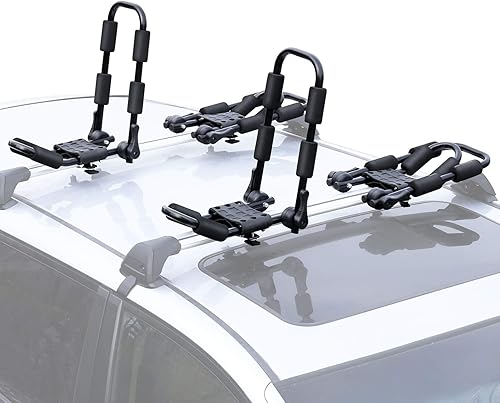
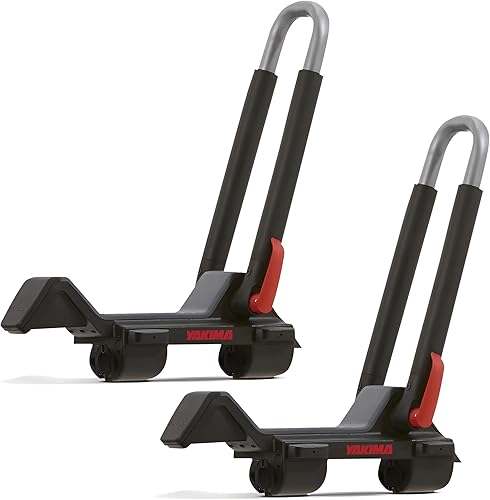
A J-cradle rack carries the kayak on its side at an angle. This design is popular because it saves roof width and can leave room for another kayak or a narrow cargo accessory. For the Jeep Compass, a J-rack often makes sense when you carry one recreational kayak, own a fairly light boat, and want to keep the setup compact.
The drawback is loading height. Since the Compass roof is not low, lifting a kayak into a J-cradle can feel awkward, especially if you are loading alone. A 40 lb kayak may be fine for many people. A 70 lb fishing kayak is different thing entirely. The boat has to be lifted higher and then rotated into the carrier without scraping the roof or losing control.
Folding J-cradles are better for people who park in garages or do not want permanent wind drag from upright arms. A fixed J-rack is usually cheaper and simple, but the folding version makes daily driving neater when the rack is not carrying a kayak.
Saddle Racks Give Better Hull Support
Saddle-style kayak racks hold the kayak hull-down, usually on padded cradles. This is one of the better choices when the kayak is heavier, longer, or more expensive. The hull sits flatter, support is spread across a wider surface, and the kayak can feel less twitchy in crosswind.
For Jeep Compass owners, saddles also pair well with rear-loading accessories. You can place the kayak stern on the rear support, then slide the boat forward instead of lifting the whole kayak over shoulder height. That small difference is huge if you paddle often or load alone.
The main drawback is roof width. A saddle setup can take more space than a J-cradle. If you need to carry two kayaks, saddles may not leave enough room unless your crossbars are long enough and still safely within vehicle width rules in your area.
Stackers Are For Multiple Light Kayaks
Stacker racks hold kayaks upright, usually strapped on their sides against a vertical post. This can be a smart option for two lightweight recreational kayaks. It is not the first choice for a wide fishing kayak or a heavy sit-on-top kayak with molded accessories.
The attraction is efficiency. A stacker uses less rack hardware and can carry more than one boat when the roof and bar limits allow it. The risk is that each kayak need proper strap control, and a loose side-loaded kayak can shift fast in gusty wind.
For a Jeep Compass, stackers are best when the boats are narrow, manageable in weight, and the driver is disciplined about bow and stern lines. They are not ideal for people who want the quickest possible load after a long day on the water.
Load-Assist Racks May Be Worth The Extra Cost
A load-assist rack is not a luxury for everyone. It can be the difference between using the kayak regularly and leaving it in the garage because loading feels like a fight. Some systems slide, tilt, or extend down the side of the vehicle so the kayak can be loaded at a lower height.
This is especially useful on a Compass if you own a heavier fishing kayak, paddle solo, or have shoulder/back concerns. The rack costs more, but it lowers the chance of roof scratches, dropped kayaks, and rushed tie-downs. When people say they regret buying a cheaper kayak rack, loading difficulty is often the quiet reason.
The only caution is weight. Load-assist systems can be heavier than basic J-cradles. Since the Compass roof rating is finite, the carrier’s own weight must be included in the total roof load.
Check Rack Capacity Against Vehicle Capacity
A rack may claim a higher load rating than your vehicle roof allows. That does not mean you can use the higher number. The lower limit controls the setup. If the Jeep Compass roof system is rated at 150 lb, then that is the practical ceiling even if the kayak carrier says it can handle more.
For example, one multipurpose kayak/SUP carrier lists a maximum load of 59 kg or 130 lb, and the carrier itself is listed at 4.5 kg or 20 lb. Those numbers are useful, but the final safe answer still depends on vehicle roof limit, crossbar rating, and total carried weight.
This is where cheaper racks can be misleading. Some budget carriers show impressive capacity numbers, but do not always explain crossbar compatibility, clamp dimensions, torque settings, or highway speed guidance clearly. A rack that lacks clear fit details is not a bargain when the kayak is sitting over your windshield.
Measure Your Kayak Before Buying The Rack
Kayak width, length, and hull shape matter. A narrow touring kayak and a wide fishing kayak do not sit the same way in one carrier. A short 10-foot recreational kayak is often easy to manage on the Compass. A 12-foot or 13-foot fishing kayak needs better support and more careful front and rear tie-down.
Hull shape matters because pressure points can deform some plastic hulls, especially during hot weather. Sit-on-top kayaks often have flatter, wider hulls. Touring kayaks often have more defined chines. Inflatable kayaks may need a different transport approach depending on manufacturer advice.
Before buying any kayak roof rack for Jeep Compass, measure the kayak at its widest point and check the rack’s maximum boat width. Also check whether the carrier pads contact the hull properly. If the kayak sits on one hard edge or clamp point, skip that setup.
Bow And Stern Lines Are Not Optional For Longer Kayaks
The Compass manual warns that long loads extending over the windshield should be secured at both the front and rear. It also says loads should be secured to the crossbars first, with tie-down loops used only as additional securing points if needed.
This is important for kayaks because wind lift is not small. A kayak is not just dead weight sitting still on roof. At highway speed, air pushes under and around the hull. Truck traffic, side gusts, and quick braking can all add forces that straps alone may not handle well if they are badly placed.
Use cam buckle straps over the kayak body and bow/stern lines to reduce front and rear movement. Do not over-tighten to the point that the hull bends. Ratchet straps are often too aggressive for plastic kayaks, and they can crush or warp the hull if used carelessly.
Wind Noise, Fuel Economy, And Handling Should Be Considered
Any kayak rack changes airflow over a Jeep Compass. Fixed J-cradles usually create more noise than folding racks or low-profile saddles. The difference may be small on short local trips, but on long drives it can get tiring. You may hear humming from the bars, straps vibrating, or a low thump if the kayak is not seated cleanly.
Fuel economy can also drop with roof cargo. The exact loss depends on vehicle speed, rack shape, kayak position, wind direction, and trip distance. The practical advice is simple: remove the carrier when it is not needed, use folding racks when possible, and keep straps flat so they do not buzz against the wind.
Handling changes too. Roof weight raises center of gravity. A Compass is stable for normal driving, but a roof-loaded SUV should be driven with more patience. Sudden lane changes, fast cornering, and hard braking are not good habits when a 10 to 13-foot kayak is above the cabin.
Best Rack Type By Kayak Owner
For one lightweight recreational kayak, a folding J-cradle is often the most balanced choice. It saves roof space, fits many crossbars, and folds down when not in use. It is not the gentlest option for heavy kayaks, but for casual paddlers it works well.
For one heavy fishing kayak, saddle racks with load assist is usually the better answer. The lower loading effort and wider hull support are more important than saving a few dollars. A heavy kayak plus high roof can become frustrating quickly.
For two light kayaks, stackers or dual J-racks can work, but only after checking total roof load and crossbar length. Two 45 lb kayaks plus rack hardware can still fit under 150 lb in some setups, but two heavier kayaks will often exceed safe margin.
For premium touring kayaks, saddles usually deserve first look. They support the hull better, reduce pressure points, and feel more secure during longer highway drives.
Do Not Ignore Crossbar Quality
The kayak carrier is only as good as the bars it grips. Cheap crossbars may flex, whistle, rust, or loosen under repeated loading. Aero bars cost more, but they often reduce wind noise and look cleaner on a compact SUV like the Compass. Square bars are strong and simple, but may be noisier. Round bars are versatile, but some carriers need extra care to stop rotation.
The crossbars must also match the rail system on your exact Compass. Raised rail clamps are not same as flush rail feet. If the vehicle has no rails, a fit kit may be needed. This is where buying by vehicle year, trim, and roof style becomes more important than buying by “universal fit” wording.
A proper crossbar setup should sit level, clamp firmly, and allow enough spread between bars. If the bars are too close, the kayak can pivot more under wind load. If the bars are too far for the rack design, the carrier may not mount correctly.
Padding And Strap Quality Are Small Details With Big Consequences
Good padding prevents scuffs, hull dents, and annoying movement. Thin foam on low-cost racks may compress quickly. Better racks use thicker rubber or shaped pads that hold the kayak without biting into the hull.
Straps matter just as much. Cam buckle straps are the usual choice because they are strong, adjustable, and less likely to overtighten than ratchets. Look for straps with protective buckle covers so the metal does not chip paint or hit glass.
After the first 10 to 15 minutes of driving, stop and recheck the straps. Kayaks often settle slightly after wind and vibration start working on them. This is not overthinking it, it is basic roof-load discipline.
Security Features Matter If You Stop On Trips
Kayaks and racks are easy targets when left on a vehicle at trailheads, hotels, fuel stations, or roadside restaurants. Locking rack cores, lockable straps, and cable locks add cost, but they are useful if you travel with expensive gear.
A lock does not make a kayak theft-proof, but it slows down casual theft. For a Jeep Compass owner who paddles locally and removes the rack after each trip, locks may be less important. For road trips, they are worth considering.
Also remember that security hardware adds some weight and time. Keep the setup practical. The best system is one you will actually use properly every time.
Cheap Kayak Racks Can Work, But Inspect The Weak Points
Budget J-racks can be fine for occasional short trips with a light kayak. The key is to inspect welds, clamp plates, bolts, pads, and straps before trusting them. Some cheap racks use soft hardware that can loosen or rust quickly.
Check whether the rack includes bow and stern tie-downs. Check whether the clamps fit your crossbars without forcing. Check whether the bolts are long enough for your bar shape but not so long that they hit the roof. These small things decide whether a “universal” carrier is actually usable.
For regular highway travel, heavier kayaks, or solo loading, it is usually smarter to buy a better rack once than replace a weak one later.
A Simple Buying Checklist For Jeep Compass Owners
Before buying, confirm your Compass roof rating and roof style. Then weigh your kayak or check its listed hull weight. Add the weight of crossbars and carrier. If the total is too close to 150 lb, choose a lighter setup or reconsider carrying that kayak on the roof.
Next, measure crossbar spread and kayak width. Match the rack to the hull, not just the vehicle. A wide fishing kayak needs more support than a narrow recreational kayak. A long kayak needs reliable bow and stern control.
Finally, think about how you load. If you often paddle alone, a rack that is technically strong but hard to load may be a poor choice. Ease of loading is part of safety, not only convenience.
Final Verdict
The best kayak rack for Jeep Compass is the one that stays inside the vehicle roof limit, fits the exact crossbar system, supports your kayak hull correctly, and makes loading realistic for your body and routine. For most casual paddlers, a good folding J-cradle is the most practical pick. For heavier fishing kayaks, saddle racks with load assist are usually more sensible. For two light kayaks, stackers can work, but only with careful weight math and proper tie-downs.
Do not buy only by price or by claimed rack capacity. Start with the Jeep Compass roof limit, then work down to kayak weight, rack type, crossbar spread, and loading method. That order will save you from a noisy, unsafe, or annoying setup, and it will make every trip to the water feel less like a wrestling match with your own gear.





 Best 6 Rated Kayak Storage Racks
 Best 6 Budget Kayak Roof Racks
 Best 5 Fishing Kayak Roof Racks